by Ron Wodaski
The CCD camera has revolutionized the art of astrophotography. CCD cameras are becoming more affordable, and more and more amateur astronomers are capturing the wonders of the heavens in their own backyards. This book will take you by the hand through every part of the CCD imaging process.
A sample chapter is included here online so you can get a feel for how the book organizes and presents information. The focus, if you will pardon the obvious pun, is on providing detailed step-by-step information for beginners and intermediate imagers. You will see exactly how to focus, expose, and process images. Along the way, you'll learn hundreds of tips that will help you get good-looking images in a fraction of the time it would take by trial and error experimentation.
Author's note: I was very
disappointed to learn how long it takes to get a book published. In order to make
this information available immediately, I am making the book available
online before it is published. This allows you to start learning now.
Read the sample chapter. If you like what you read, and want the full
content of the book online, you can subscribe to the web version of the
book for $9.95. You'll also gain access to a CCD discussion group hosted
by the author, where you can upload images for feedback, ask questions,
talk with other imagers, etc. I have set up a as well as a for anyone who would like to learn more.
Web Subscription $9.95The web subscription gives you access to everything on the web site, including the full content of the book as it is being written. |
||||
| For other ordering options, including the printed book, please visit the Order Page. |
|
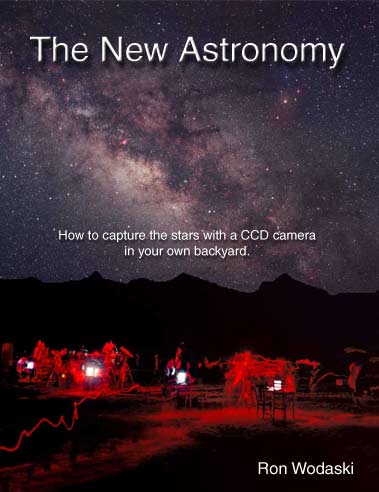
Cover photo: © Tony Hallas
About the cover photo
Subscribers log in here
Part Two: Taking Great Images
- Chapter 4: The Hardware You Need
- Chapter 5: Taking Guided Exposures
- Chapter 6: Increasing Image Quality
- Chapter 7: Color Imaging
Part Three: Image Processing
| Type of object | Object name and thumbnail | Description |
| Medium difficulty, but small. Interesting details when imaged at longer focal lengths. |
M1
|
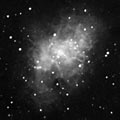
M1, The Crab Nebula, is rising earlier in the east. It is up high enough to image by 10 or 11pm local time. This is good target for those with longer focal length instruments. When the seeing is good, and your technique is good, you will get a lot of complex, interesting detail. This is also a good target for color imaging, with lots of red knots throughout. it's a little small for the wide-field imager, but if you've got sharp optics you can show good detail with any scope over 500mm focal length. M1 is reasonably bright, and moderate exposure lengths (varies with your camera, but 2 minutes is my definition of moderate) will be enough to show some detail. |
| Large, dim object, best suited to dark skies and wide-field setups. |
M33
|
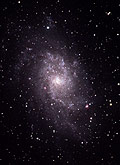
M33 is large and extremely well placed by mid-evening, nearly at the zenith. This gives you the darkest part of the sky to image this father faint galaxy in, and should help you get more detail out of it. It's a large object, very suitable for wide-field scopes, but light pollution can easily overwhelm any details. Long exposures, and at least three or more of them, are needed to get a really clean, detailed image of M33. Exposure times vary by camera, of course, but five minutes is a good starting point per exposure, minimum, unless you get blooming, in which case you'll have to go shorter. |
| A small planetary with interesting but dim outer details |
M76
|
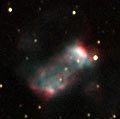
If you've got a lot of focal length (2000mm or more) and reasonable dark skies, M76 is also high in the sky at a convenient time. For most of you, it will be at the zenith and a little to north; for me here near Seattle, it's nearly directly overhead. Long exposures will be rewarded with some nice, dim details outside the well-known contours of this object; it has faint streamers outside the basic dumbbell shape. |
| Bright stars limit this one to either extreme wide field (camera lens) or anti-blooming chips. |
Pleiades (M45)
|
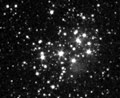
If you have an anti-blooming camera, consider shooting the Pleiades. The stars are exceptionally bright, and you'll need and antiblooming camera in order to avoid huge blooms. There is good detail available in the nebulosity round this cluster of stars, but you will have to see if you can expose long enough to capture it. Oddly enough, when imaging this cluster with a 50mm camera lens attached to my ST-8E, I picked up some of the nebulosity prior to blooming. You'll want to go for the longest exposure possible to get good detail in the nebulosity. The maximum length will be determined by the way that anti-blooming is set up on your camera. If blooming _would_ occur after, say, 5 seconds, and if you've got 100x anti-blooming factor, then you could shoot for as much as 500 seconds before blooming would set in. The protection factor varies; check your camera docs or contact the manufacturer to find this out. It's useful information, as it will give you some idea of just how long you can expose without problems. The image at left was taken with an ST-8E and a 50mm camera lens. |
| There are lots of cool objects in and around Orion; take you pick! |
Orion area goodies
|
Orion's myriad of objects will be well up to the south after midnight, with excellent imaging opportunities from 1am on. For those of you with wide-field instruments, two objects in particular are worthy of your attention. The Witch-Head Nebula, near Rigel, is very faint and will require long exposures and very dark skies, but it is a challenging subject that is well worth the effort. Somewhat brighter and easier is the Rosette Nebula, east of Orion's Betelgeuse. There is beautiful, intricate detail in both the nebula and some dust lanes. Other excellent target in and near Orion include: |
| A classic; worth the time to get a good image. Very bright core and very dim outer reaches make it an interesting challenge to get full extent. |
M42
|
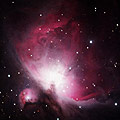
M42, the Great Nebula in Orion. Big! Beautiful! best for wide field, but the core is interesting even in longer focal lengths. North of M42 is the Running Man (see below), which is dimmer and more challenging to image. |
| Dim, but a real favorite. A great subject for color shots, especially if you can include Flame nebula in same field. |
Horsehead Nebula
|
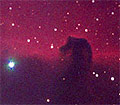
Horsehead. This is a favorite of nearly everyone. It's very challenging, especially for wide-field imagers, because the Horsehead is dim, and it is located very close to a very bright star, Alnitak. The nearby Flame is also a beautiful subject, but it is even closer to Alnitak and therefore extremely challenging on your optics. |
| Dim but very interesting details. Especially interesting in color with the darker dust lanes. |
Running Man (NGC 1977)
|
The Running Man (NGC 1977) - very close to M42/43, but dimmer. Dark skies and longer exposures (5+ minutes) will help bring out detail and nebulosity. This is an excellent object for very long color exposures, as the dust lanes have deep purple hues. The image at left was processed heavily to bring out color and detail; long exposures are best for this object. |
| I have not images these yet; let me know what you find out! |
Christmas Tree Cluster, Cone Nebula [image needed!] |
The Christmas Tree Cluster and Cone Nebula are a little further east past the Rosette. Interesting and somewhat detailed, worth some of your time once you've got the high-profile subjects covered. The nearby nebula IC 2169 has some interesting structure for those of you with longer focal length scopes. |
| Core is small but interesting in detail. Outer areas require long exposures. |
M77
|
An earlier "object of the month," M77, is well-placed in the south and is still worthy of some attention. The core is very bright, and there is a large dim area around it that makes for a good imaging challenge. |
| A beautiful supernova remnant; ideal for hydrogen alpha filtered exposures, but also a good challenge from a dark sky site. |
IC 443
|
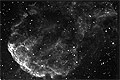
Just
east of M1 is a pretty cool-looking but often overlooked supernova
remnant, IC 443. This one looks challenging but very rewarding if you
can manage a really dark site and very long exposures. It's quite
large, nearly a degree, so a wide-field scope will be needed.
Image of IC 443 courtesy of Joseph Marietta |